Digital Marketing Strategies for Businesses in Muscat: A Practical 2026 Guide
An actionable 2026 digital marketing guide for Muscat businesses covering local SEO, Google Ads, bilingual content, conversion tracking and a realistic 90-day roadmap.
- Table of Contents
- Start with Muscat customers, not channels
- Segment by intent and service area
- Make your website useful before buying traffic

The most effective digital marketing strategy for a business in Muscat is a focused system: understand your customers, make your website easy to use, appear for relevant searches, test paid and social channels selectively, and measure qualified enquiries rather than vanity metrics. The right mix depends on whether you sell locally, serve customers across Oman or operate in a specialist B2B market.
These digital marketing strategies for businesses in Muscat give owners and marketing teams a practical way to prioritize work in 2026 without assuming every business needs every channel.
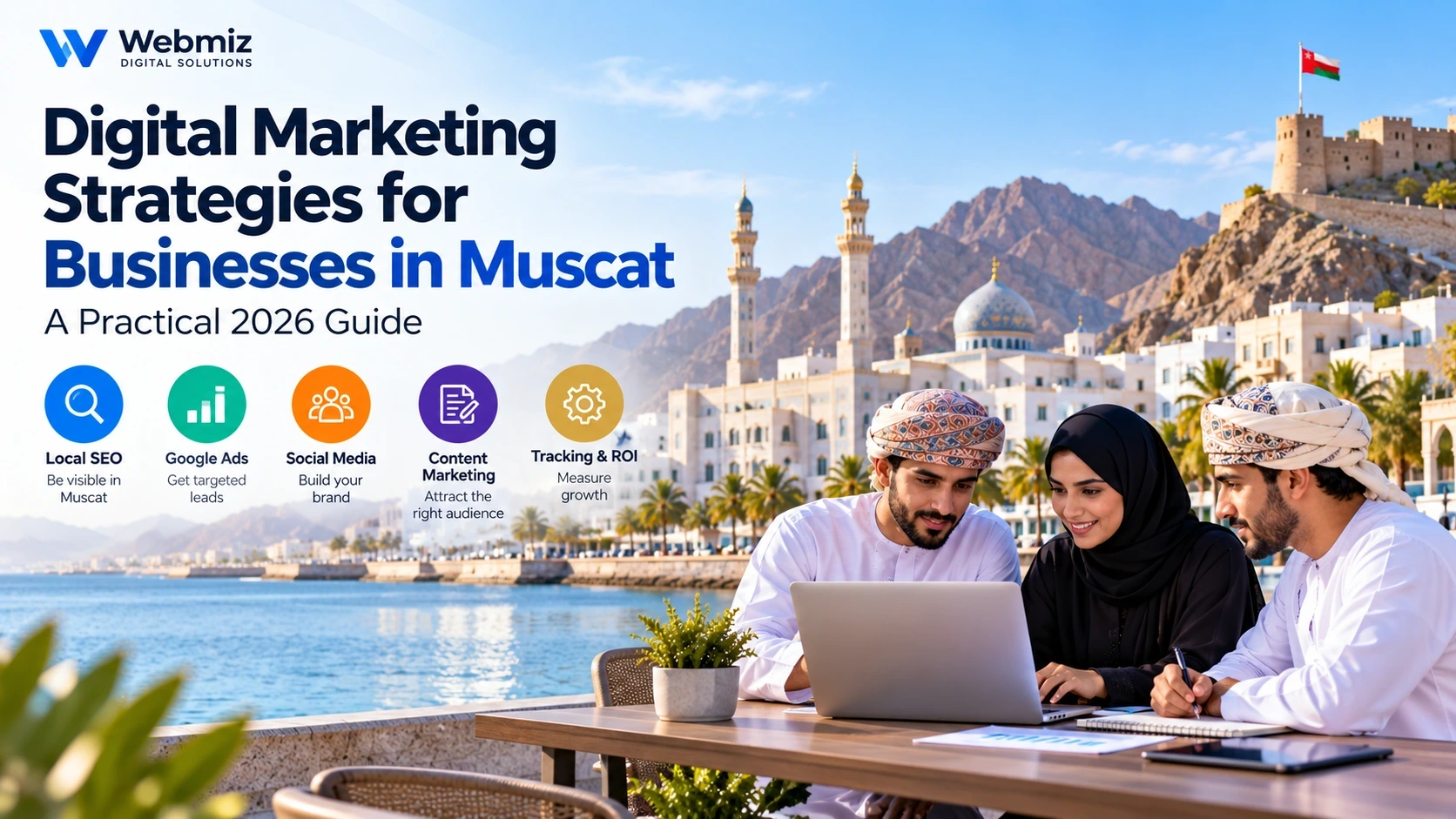
Table of Contents
Start with Muscat customers, not channels
Map who buys, why they buy and what they need to know before contacting you. A restaurant serving nearby residents and visitors needs a different plan from an engineering supplier targeting purchasing managers. Interview your sales team about frequent questions, lost enquiries and purchase triggers. Separate urgent, high-intent searches from broader discovery and comparison searches.
Segment by intent and service area
Define your real delivery or service footprint rather than targeting all of Oman automatically. A business serving Al Khuwair and Qurum may need different location signals from one delivering across the Muscat Governorate. Use real customer data to determine whether Arabic, English or bilingual content is warranted. Do not create near-identical neighborhood pages just to capture keywords.
Make your website useful before buying traffic
Explain your offer clearly above the fold, show relevant product or service details, and make enquiry routes obvious on mobile. Test click-to-call, forms, maps and WhatsApp links if your customers use them. Include delivery boundaries, working hours and any important eligibility conditions. A landing page should answer the questions that appear in actual sales conversations.
Measure the conversion journey
Record completed forms, meaningful phone calls and qualified enquiries with appropriate consent and privacy controls. Distinguish a click from a genuine prospect. If you cannot reliably measure outcomes, start with a small tracking and usability audit before scaling campaigns.
Build local search visibility where eligible
For a genuine customer-facing location or qualifying service-area business, keep your Google Business Profile accurate: business name, category, hours, contact details and relevant photographs. Google sets specific eligibility rules; do not create a profile for a virtual address or claim a local office you do not operate. Read Google’s Business Profile guidelines.
Build informative service pages that answer distinct customer needs, keep navigation logical and publish original resources about purchasing decisions. A Muscat-focused educational article should not simply repeat the commercial claims on a service page. Learn more about Webmiz’s SEO approach.
Use Google Ads for identifiable demand
Begin with tightly grouped search campaigns for products or services people actively seek. Separate brand searches, high-intent service terms and broader research queries. Review actual search terms, exclude irrelevant intent and connect each ad to a useful destination page. For a B2B equipment distributor, a request-for-quotation conversion can matter more than raw website visits.
Decide the test budget from the economics of your business—not an unsupported average cost-per-click claim. Keep media spend separate from agency fees, review lead quality weekly and change bids or messaging only after collecting enough meaningful evidence.
Publish bilingual content only when it serves users
Arabic and English can both be relevant in Muscat, but the right mix depends on the customer segment. Research the terms customers actually use, write naturally for each audience and review translated copy with a competent language reviewer. Avoid automatic duplication of English articles into poorly localized Arabic pages.
Useful content ideas include product comparisons, service preparation checklists, buying guides, maintenance advice and explanations of common quotations. For example, a facilities-services provider could explain how to scope a maintenance contract, with a transparent checklist rather than an unsupported “best company” ranking.
Google’s people-first content guidance is a useful standard for assessing editorial quality.
Use social media for proof and discovery
Choose platforms based on your buyers and your capacity to publish consistently. Short videos can demonstrate a service process; a sequence of photographs can explain a product installation; staff answers to recurring customer questions can establish clarity. Ask permission before sharing customer images or identifiable details. Link posts to relevant service information rather than sending every visitor to a generic homepage.
Do not judge social activity only by likes. Track meaningful messages, website visits, enquiries and assisted conversions where measurement is possible.
Connect reporting to qualified enquiries
Create a compact scorecard with organic clicks and queries, paid search spend and conversions, landing-page conversion rate, qualified leads and sales follow-up outcomes. Google Search Console reports search visibility, while analytics and your CRM answer different questions. Consult Search Console’s performance report documentation for metric definitions.
For example, if a campaign brings twenty enquiries but only three fit your service area, investigate targeting and message clarity before increasing spend. Use directional findings carefully: small sample sizes and offline sales processes limit attribution.

A practical 90-day implementation plan
Days 1–30: diagnose and establish a baseline
Interview sales staff, audit mobile usability and tracking, review Search Console queries, inspect your business profile eligibility and document conversion definitions. Fix the highest-friction contact issues first.
Days 31–60: launch focused improvements
Improve the highest-value service pages, publish one genuinely useful buying resource, test a narrowly targeted paid campaign if appropriate, and create a manageable social content workflow. Review lead quality every week.
Days 61–90: refine using evidence
Compare enquiry quality by channel and page, address irrelevant search terms, improve weak calls to action, and prioritize content gaps based on actual questions. Retain changes that improve meaningful business outcomes; avoid treating a three-month window as a guarantee of organic rankings.
Muscat marketing execution checklist
- Define your buyer, service footprint and one primary conversion.
- Test every mobile contact route and landing page.
- Confirm Google Business Profile eligibility before optimization.
- Research Arabic and English intent separately where relevant.
- Keep paid media costs and management fees transparent.
- Publish original answers to recurring customer questions.
- Review qualified leads, not just impressions and clicks.
- Assign owners for weekly review and sales follow-up.
Frequently asked questions
Should a new Muscat business start with SEO or Google Ads?
It depends on how urgently you need feedback, whether people already search for your offer and how well your website converts. Paid search can test demand sooner; SEO is an ongoing investment in useful pages and technical accessibility. Many businesses benefit from a measured mix.
Does every Muscat business need Arabic and English pages?
No. Let customer language preferences and research behavior guide the decision. High-quality content in one appropriate language is more useful than inaccurate bilingual duplication.
How can a small team measure marketing success?
Start with a simple enquiry log showing source, service requested, qualification and outcome. Pair it with website and advertising analytics, then improve data quality as the operation grows.
Conclusion and next steps
Muscat businesses do not need an oversized marketing stack. They need accurate audience research, trustworthy content, measurable acquisition and disciplined follow-up. Prioritize the bottleneck that currently prevents customers from discovering or contacting you, then expand based on evidence.
If you plan to outsource implementation, use our Oman digital marketing agency selection guide to compare scope, reporting and account ownership.
For help reviewing your channels, explore Webmiz Digital Solutions’ digital marketing services. A practical discussion can identify what to audit first and which improvements fit your goals; rankings, leads and revenue cannot be guaranteed.